
Trader's 'Offline' Freedom: Re-understanding the Ultimate Value of Automation Tools
Trader's 'Offline' Freedom: Re-understanding the Ultimate Value of Automation Tools
Published on: 8/28/2025
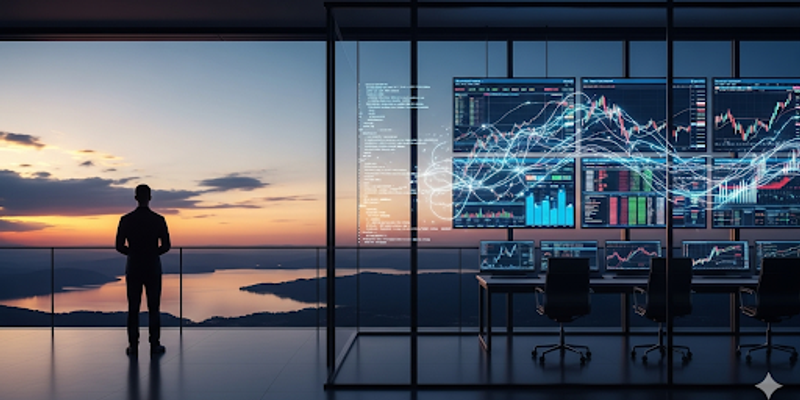
I. Introduction: The You Who Wakes Up at 3 AM Needs an Answer
When was your last 'offline' moment?
I'm not referring to airplane mode or a signal dead zone, but the moment your brain truly stops processing K-line fluctuations, funding rates, position risks, and community sentiment. It's the moment you don't have to smile and nod at a family dinner while glancing at the flashing red and green numbers on your phone screen. It's the moment you can immerse yourself in a movie without worrying about a 'black swan' quietly arriving when you take off your headphones.
For every serious trader, this is a luxury, even an unattainable fantasy.
The market is a never-sleeping beast, binding every participant firmly to their screens with 24/7 volatility and massive information flows. We study technical analysis, delve into macroeconomics, and track every clue that might affect prices, trying to build our cognitive edge in this chaotic sea. However, we soon discover a cruel 'impossible trinity':You can hardly simultaneously possess perfect execution timing, deep strategic thinking, and a healthy mind and body.
When an opportunity arises at 3 AM, your body is asleep; when your strategy demands iron discipline, your emotions waver between fear and greed; when you try to focus on review and research, trivial monitoring tasks constantly erode your most valuable cognitive bandwidth.
We are like an artisan trying to build a skyscraper alone, having to draw blueprints, carry bricks and cement, and personally tighten every screw. The result is often that blueprints are full of errors due to scattered energy, and brick walls are crooked due to physical exhaustion. We fall into a trap of 'low-level diligence'—investing all our time and energy, but constantly repeating execution-level operations, neglecting the top-level strategic design that truly determines success or failure.
This pain point is so real, so universal. It has nothing to do with your capital size or trading experience. It is a structural dilemma, stemming from the inherent limitations of human physiology and psychology, and the fundamental contradiction with the perpetually operating digital market.
And the automated trading tools (Trading Bots) we are discussing today are precisely the answer born to break this 'impossible trinity.' But their value is far more profound than what the four words 'automatic buying and selling' suggest.
II. Core: From Executor to Architect – A Threefold Reconstruction of Value
Setting aside the myths of 'millions annually' and the exaggerated claims of 'one-click effortless wins,' let's examine what automated tools truly bring to traders from a perspective closer to their essence. It is not magic, but a precise system, whose core value can be deconstructed into three progressive dimensions.
First Layer of Value: Liberation of Strategy – Becoming an 'Architect,' Not a 'Bricklayer'
Imagine you are a top architectural designer, conceiving the blueprint of a magnificent building in your mind. This blueprint includes complex mechanical structures, ingenious spatial layouts, and avant-garde artistic concepts. However, in actual construction, you are required to personally mix cement, lay every brick, and install every inch of wiring.
What would be the result? Most of your energy would be consumed by these repetitive, low-creativity tasks. You wouldn't have time to optimize the blueprints, nor the mental capacity to conceive grander designs, and might even make a fatal mistake on a critical load-bearing wall due to fatigue.
This is precisely the true portrayal of a manual trader.
The trading strategy you painstakingly researched—whether it's trend following based on multiple timeframes or a complex arbitrage model—is that 'architectural blueprint.' It is the crystallization of your wisdom, the core of trading. And operations like monitoring the market, placing orders, setting stop-losses, and taking profits are 'carrying bricks and laying walls.' They are crucial, but essentially repetitive execution tasks.
The first thing automated tools do is free you from the role of a 'bricklayer.'
It becomes your most loyal, precise, and tireless 'construction team.' You simply hand over the clear, quantified 'blueprint' (trading strategy) to it, and it will execute day and night with millisecond precision. This liberation brings not only time savings but also a cognitive leap.
You can finally dedicate 100% of your energy to the role of an 'architect':
- In-depth Review: No longer reviewing profits and losses based on intuition, but quantitatively analyzing every aspect of the strategy based on precise data recorded by the tool.
- Strategy Iteration: You have more time to research new market paradigms, learn more complex models, allowing your 'blueprint' to continuously evolve.
- Macro Insights: Detaching from complex micro-operations allows you to stand at a higher dimension, observe long-term structural changes in the market, and capture fleeting, decisive macroeconomic opportunities.
This is the first layer of value of automated tools—they don't replace your thinking, but rather defend and empower your higher-level thinking by taking over execution.
Second Layer of Value: Emotional Isolation – Building a 'Firewall' Between Reason and Trading
The market is an amplifier of human nature. Every trader has, at some point, been betrayed by their own emotions.
After consecutive profits, greed makes you forget rules and over-leverage; after unexpected losses, fear makes you exit too early, missing a rebound; when missing a rally, anxiety drives you to chase highs, buying at the peak. We all understand the adage 'plan your trade, trade your plan,' but in moments of adrenaline surge, discipline often crumbles.
Many believe the advantage of automated tools is 'lack of emotion.' This statement isn't entirely accurate. A more precise description is that,it builds a robust 'firewall' between your emotional human brain and the cold trading execution button.
Your trading decisions still originate from you—the flesh-and-blood you, who can be excited and frustrated. In a calm, rational state, you set well-thought-out rules (entry points, exit points, position sizes, stop-loss logic). This is the crystallization of your wisdom as a 'rational person.'
When the market fluctuates violently and begins to trigger your emotions, this 'firewall' activates. The tool doesn't feel the market's frenzy or panic; it only recognizes one thing: your preset rules.
- If the price hits the stop-loss line, it will execute without hesitation, even if your heart is praying a thousand times, 'Wait, maybe it will rebound.'
- Upon reaching the preset profit target, it will decisively take profits in batches, even if greed is whispering in your ear, 'Don't leave, this wave can go to the moon.'
It acts like a mirror, reflecting not the market's emotions, but your initial, most rational decisions. It forces you to adhere to the discipline you set. This enforcement might cause you to miss some unplanned 'windfalls' in the short term, but in the long run, it helps you avoid countless catastrophic losses driven by emotion.
This is the second layer of value of automated tools. They don't eliminate your humanity, but protect your rationality, allowing your wisest 'you' to overcome your most impulsive 'you.'
Third Layer of Value (Contrasting View): The Ultimate Mirror – A 'Brutal Documentary' About Yourself
Now, let's discuss a perspective that is most counter-intuitive, yet also the most profound.
The industry is filled with voices claiming: A good automated tool can help you make money. This is a beautiful misconception. The truth is:A good automated tool will reveal to you, in the most efficient and ruthless way, just how excellent, or... how terrible, your strategy truly is.
It is the ultimate mirror, an unvarnished 'brutal documentary' about your trading philosophy.
When you trade manually, the outcome is often ambiguous. A profit might be attributed to your 'market feel'; a loss might be blamed on 'the market being too erratic' or 'bad luck.' It's difficult to clearly define whether the issue lies with the strategy itself or with execution errors.
But automated tools strip away all excuses.
Because it achieves 100% unbiased execution, the quality of trading results points solely and unequivocally to your strategy itself.
- If your strategy has a logical flaw, the tool will precisely and repeatedly lose money on that flaw until you can no longer ignore it.
- If your strategy fails in a specific market cycle (e.g., transitioning from a trending market to a volatile one), the tool will clearly delineate this 'failure boundary' with a series of drawdowns.
- If your strategy is truly excellent, it will also prove how correct your understanding is with a smoothly ascending equity curve.
Therefore, the highest value of automated tools is not to directly generate profit, but to serve as a ruthless 'strategy validator.' It forces you to move from 'feeling-based' trading to 'quantitative' trading; from searching for an accidental 'holy grail' to building a sustainable trading system with positive expected value. It won't make a mediocre strategy profitable, but it can enable an excellent strategist to quickly recognize and refine their strategy, thus moving towards true professionalism.
This process can be painful because it starkly exposes every blind spot in your cognition. But only by undergoing this 'mirror' test can a trader truly transform from a retail investor to a systematic trader.
III. Sublimation: From Tool to Freedom – Humanity's Eternal Theme
When we zoom out from trading itself, we find that this discussion about automated tools actually aligns with a grand theme in the evolution of human society:Why do we create tools?
From ancient stone axes to industrial-era steam engines, and then to information-age computers, the ultimate purpose of human tool creation has never been to make ourselves 'lazier,' but to liberate ourselves from low-level, repetitive constraints, to explore and realize higher-level values.
Stone axes freed early humans from spending all their time foraging for food, giving them time to gaze at the stars and ponder 'who we are, where we come from.' Steam engines liberated humanity from heavy manual labor, leading to an unprecedented flourishing of modern science, art, and culture.
Similarly, the ultimate significance of automated trading tools lies not in the alluring profit curve, but in the 'offline' freedom they grant traders—'offline' freedom.
This freedom is the freedom of time, allowing you to reclaim your life, spend time with family, and develop a hobby unrelated to trading.
It is even more the freedom of mind, allowing you to withdraw from the constant price battles and engage in grander thinking: What is the long-term value of this industry? Where is the next structural opportunity? What else do I want to create in my life besides trading?
When machines begin to handle precise 'tactical execution,' human value becomes prominent in areas where machines cannot replace it:Grand strategic vision, extraordinary artistic intuition, profound philosophical contemplation, and an intrinsic curiosity and love for the complex world.
This is not about you staying away from the market, but advocating for a healthier, more sustainable symbiotic relationship. You are no longer a slave to the market, but its calm observer, an elegant co-dancer. Your value is no longer determined by your online hours, but by the depth of your offline thinking.
IV. Conclusion: When Machines Start Executing, Where Should You Go?
We are fascinated by tools, essentially by a sense of control. We hope to control an uncertain future through faster speeds and stronger computing power.
However, the essence of the market is precisely a collection of 'uncertainties.' Any attempt to control it 100% will ultimately backfire.
The emergence of automated trading tools presents a fascinating paradox:When we try to use them to strengthen control over the 'external world' (the market), we find that their most profound value lies in helping us achieve control over our 'inner world' (the self).
They control our fluctuating emotions, our often lax discipline, and ruthlessly reflect every prejudice and flaw deep within our cognition. They are like a strict Zen master, forcing us to confront our truest selves through absolute adherence to rules.
So, the crux of the problem may have changed. We should no longer ask, 'Which tool can help me make the most money?' but rather a deeper question:
'When machines start executing, where should you, as a 'human,' go?'
Your insight, your creativity, and your strategic vision will be your only and ultimate moat in this new wave of human-machine collaboration. Automated tools merely win you the time and space to ponder these ultimate questions.
This, perhaps, is the answer most worthy of deep thought for each of us in this technological revolution.